The stock market under President Trump has been anything but boring. It has delivered strong gains, fast rallies, and sudden drops that grabbed headlines. That mix has investors asking a simple question: Is another big crash coming soon?
The honest answer is not so simple. The data shows real risks, but it also shows strong support under the surface. Markets have taken hits before, and they have bounced back every single time.
President Trump’s time in office has produced eye-catching returns. The Dow Jones rose 57%, the S&P 500 climbed 70%, and the Nasdaq surged 142% during his first term. His second term also started strong, with the S&P 500 up 16% from January 2025 to January 2026.
Annual returns during his second term rank among the best seen in over a century, which keeps investors interested and money flowing into stocks.
That said, the ride has not been smooth. The COVID-19 crash in early 2020 erased 34% from the S&P 500 in just 33 days. Another sharp drop came in April 2025 after new tariffs were announced, sending the index down 10.5% in two days and nearly 20% in the following weeks.
Valuations are Flashing Warning Signs

Jakub / Unsplash / One of the biggest concerns right now is how expensive stocks look. The Shiller P/E ratio, which tracks long-term valuations, sits above 41 as of early 2026.
That level is far above its historical average of 17.33.
This matters because past spikes in this ratio often came before major declines. The last five times it crossed 30, markets later fell between 20% and 89%, which makes current levels hard to ignore.
Still, high valuations do not guarantee an immediate crash. They suggest lower future returns and higher risk, not a fixed timeline. Markets can stay expensive for longer than most people expect, especially when earnings stay strong.
Trade policy has been a major source of market stress. The April 2025 tariff move caused a sudden sell-off, and ongoing uncertainty has kept businesses cautious about spending and hiring.
Research has already shown that earlier tariffs hurt productivity, jobs, and profits in affected industries. Even after some tariffs were rolled back, the overall trade environment remains unclear, which makes investors uneasy.
Global events are adding another layer of risk. The Iran conflict in early 2026 pushed oil prices up more than 40%, and they remain about 50% higher than at the start of the year.
Higher oil prices can lead to rising inflation, which hurts both consumers and companies. If inflation climbs again, it could slow spending and put pressure on stock prices later in the year.
Full-Blown Crash Still Looks Unlikely
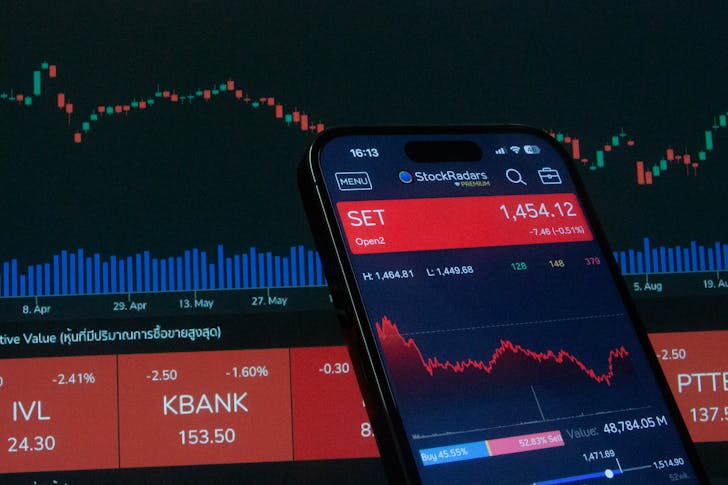
Stock / Pexels / Despite all these risks, there are strong reasons to stay grounded. The stock market has gone through more than 30 corrections over time, and it has recovered from every single one.
That long-term trend matters more than short-term swings. Even after steep losses, markets have consistently moved higher over time, driven by growth in earnings and innovation.
Right now, some key fundamentals still look solid. Corporate earnings grew 13.4% in late 2025, and consumer spending remains steady thanks to a strong job market and lower taxes.
The Federal Reserve has also cut interest rates, which supports borrowing and investment. These factors act like a cushion, helping limit how deep any downturn might go.
Another interesting shift is how investors react to news. Markets used to panic more easily, but now traders often expect quick reversals after sharp drops. This has created a habit of buying during dips. Many investors believe that policy threats may soften over time, which reduces the chance of a prolonged sell-off.