Managing money can feel overwhelming, especially when expenses come from every direction. For years, Jess* struggled to stay in control of her finances. Credit card debt piled up, savings felt out of reach, and budgeting never seemed to stick. Then a single change in her payday routine shifted everything—and within two years, that shift helped her set aside more than $12,000.
“It’s the only thing that’s worked for me,” she shared with Mamamia. “I have always been so bad with money, had credit card debt and all sorts of stuff.”
That changed when she introduced a structured system that gave every dollar a clear purpose.
A Payday System Built for Real Life

Freepik AI | Jess secured her future by splitting weekly pay into 15 specialized spending accounts.
Jess, a business owner and single mom of three, faced constant financial pressure. Irregular income streams and daily expenses made planning difficult. After adjusting her routine, she finally experienced something new—consistent savings.
“Once I changed it up… I actually got savings for the first time in my life,” she explained.
The method is straightforward but highly intentional. Each week, her income is divided across 15 separate accounts. Every expense category gets its own allocation, which removes guesswork and limits overspending.
This approach is especially effective for individuals who struggle with impulse spending or attention challenges. Jess noted, “I need to do this because of my ADHD. Otherwise, I’ll spend it all.”
Jess earns most of her income through her stationery business, along with additional roles as a wedding and funeral celebrant, support worker, and parenting payments. She pays herself $1,500 weekly, then distributes that amount across fixed categories, including her mortgage and investments.
Each dollar is assigned before it can be spent. That clarity has made a noticeable difference.
Detailed Breakdown of Weekly Expenses
Her financial structure covers both essentials and long-term goals. Here’s how the weekly allocation currently works:
Mortgage payments exceed the minimum requirement. The required amount is $295 per week, but $340 is transferred regularly. An additional $65 is sometimes added to reduce the loan faster.
Bills take up around $400 weekly. This includes utilities, subscriptions, gym fees, and property rates. Even the kids’ allowance comes from this category.
Groceries are budgeted at $300 per week. However, rising costs and feeding two teenagers and a 10-year-old often push that number higher.
Fuel expenses are set at $100 weekly, recently increased by $60 due to rising petrol prices.
Seasonal and occasional spending is also covered. Christmas receives $20 weekly, while children’s birthdays are set at $10. Gifts for friends and family are allocated $15 each week.
An emergency fund receives $32 weekly. This has already proven useful, especially after a past flood required a $1,000 insurance excess.
A $30 weekly “adventures” fund supports family outings. Beauty and hair expenses total $28 per week, based on actual spending patterns.
Children’s clothing and school needs are assigned $15 weekly. Firewood receives around $5 weekly, building slowly for occasional use.
Long-term plans are not ignored. A holiday fund gets $40 weekly, with a goal of a future trip to Thailand.
Each child has two accounts. One receives their allowance, while another collects $2 weekly for larger savings goals.
Personal spending is capped at $150 weekly for casual expenses like coffee or social outings. However, about $50 from this is often redirected into a separate “Squirrel account,” which acts as a flexible backup fund.
That Squirrel account typically holds money for unexpected but non-urgent purchases. For example, it recently covered a $500 armchair.
Investments are also part of the plan, with $10 weekly going into micro-investing.
Why This Method Works
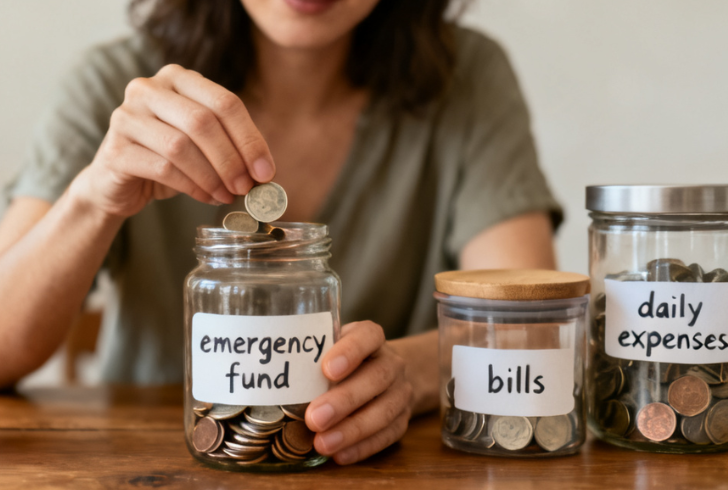
Freepik AI | Defined spending categories replace financial stress with steady, disciplined growth.
This system removes uncertainty. Instead of wondering how much is safe to spend, each category already has a limit. That structure reduces stress and builds discipline over time.
It also supports consistency. Even small amounts, when saved regularly, lead to meaningful results. Over two years, this method helped Jess build over $12,000 in savings—money that previously disappeared into unplanned purchases.
The approach encourages awareness without requiring constant tracking. Once the setup is in place, the system runs with minimal effort.
Financial Confidence Through Structure
Organizing money this way has changed more than just savings. It has improved confidence and reduced anxiety around finances.
“I’m much more financially confident,” Jess said.
While challenges remain—especially as a self-employed single parent—the structure provides stability. Lower mortgage costs also help maintain a level of comfort despite income fluctuations.
A clear system can make a significant difference, even without increasing income. By assigning every dollar a role and separating funds into specific categories, spending becomes intentional rather than reactive.
Jess’s experience shows that financial improvement does not require complex strategies. A simple payday adjustment, applied consistently, can create real progress over time.